How Route Optimization Helps Businesses Reduce Delivery Time and Operational Costs
Discover how route optimization helps businesses reduce delivery time, lower transportation costs, improve fleet utilization, and streamline logistics operations.

Why Is Route Optimization Important for Delivery Businesses?
The shortest route isn't always the most efficient route.
For a delivery business, the best route depends on much more than distance.
A vehicle may need to visit multiple customers, carry a specific load, meet delivery time windows, avoid certain roads, and return to the warehouse within a particular timeframe.
Now add multiple vehicles, multiple drivers, hundreds of orders, changing traffic conditions, and different customer priorities—and route planning quickly becomes a complex business problem.
The challenge isn't simply getting a vehicle from Point A to Point B.
Businesses need to determine:
Which vehicle should handle each delivery?
Which customer should be visited first?
What is the most efficient sequence of stops?
Can the vehicle handle the required load?
Can all deliveries be completed within their time windows?
How can unnecessary kilometers be reduced?
How can the available fleet be used more efficiently?
This leads to a more important question:
Not “What is the shortest route?” but “What is the most efficient way to complete all our deliveries?”
That is the problem route optimization is designed to solve.
Rather than planning individual journeys in isolation, route optimization looks at the delivery operation as a whole. It considers locations, vehicles, delivery requirements, capacity, schedules, priorities, and other operational constraints to help businesses create more Delivery Route Optimization.
The result isn't simply a route on a map. It is a more structured approach to managing delivery time, fleet utilization, transportation efficiency, and operational costs.
As businesses handle more orders and increasingly complex delivery networks, route optimization can become an important part of building a more efficient logistics and supply chain operation.
In this guide, we'll explore what route optimization is, how it works, how it differs from traditional route planning, and how businesses can use it to reduce delivery time and operational costs. We'll also examine industry use cases, implementation challenges, performance metrics, and how a route optimization solution can support wider supply chain operations.
1. What Is Route Optimization?

Route optimization is the process of identifying an efficient sequence of stops and assigning delivery or service tasks to available vehicles while considering operational requirements and constraints.
The objective is to help businesses complete their planned deliveries or visits as efficiently as possible.
Depending on the operation, efficiency may mean reducing total travel distance, minimizing travel time, lowering transportation costs, improving vehicle utilization, meeting Delivery Scheduling, or balancing several of these objectives.
For example, a distributor might have 50 customer orders to deliver across a city. The company has five vehicles, each with a specific carrying capacity, and customers expect their deliveries within different time windows.
Planning each vehicle's journey manually can take considerable time. A dispatcher must evaluate customer locations, vehicle availability, order quantities, delivery priorities, and the sequence of stops.
Route optimization helps organize these decisions into a more structured delivery plan.
Instead of treating each delivery as an independent journey, the business can evaluate how all the stops fit together across the available fleet.
A route optimization process may help determine:
Which orders should be assigned to each vehicle.
The sequence in which customers should be visited.
How much distance does each vehicle need to cover.
Whether the planned routes respect vehicle capacity.
Whether delivery time windows can be met.
Whether the available fleet can handle the planned workload.
Where operational constraints may prevent an efficient plan.
The exact capabilities depend on the solution and the information available to it.
Route optimization is more than finding directions
Navigation applications help drivers travel from one location to another. Route optimization addresses a broader operational problem.
A navigation application might suggest the fastest way to reach a customer from the vehicle's current location.
A route optimization solution considers the entire set of deliveries, the available vehicles, the required delivery sequence, and the constraints that affect the operation.
For businesses managing multiple vehicles and numerous daily stops, this broader perspective is important.
A route that is convenient for one driver may not be the best option for the fleet as a whole. Route optimization helps businesses evaluate the overall operation instead of making decisions on one journey at a time.
2. Route Planning vs. Route Optimization
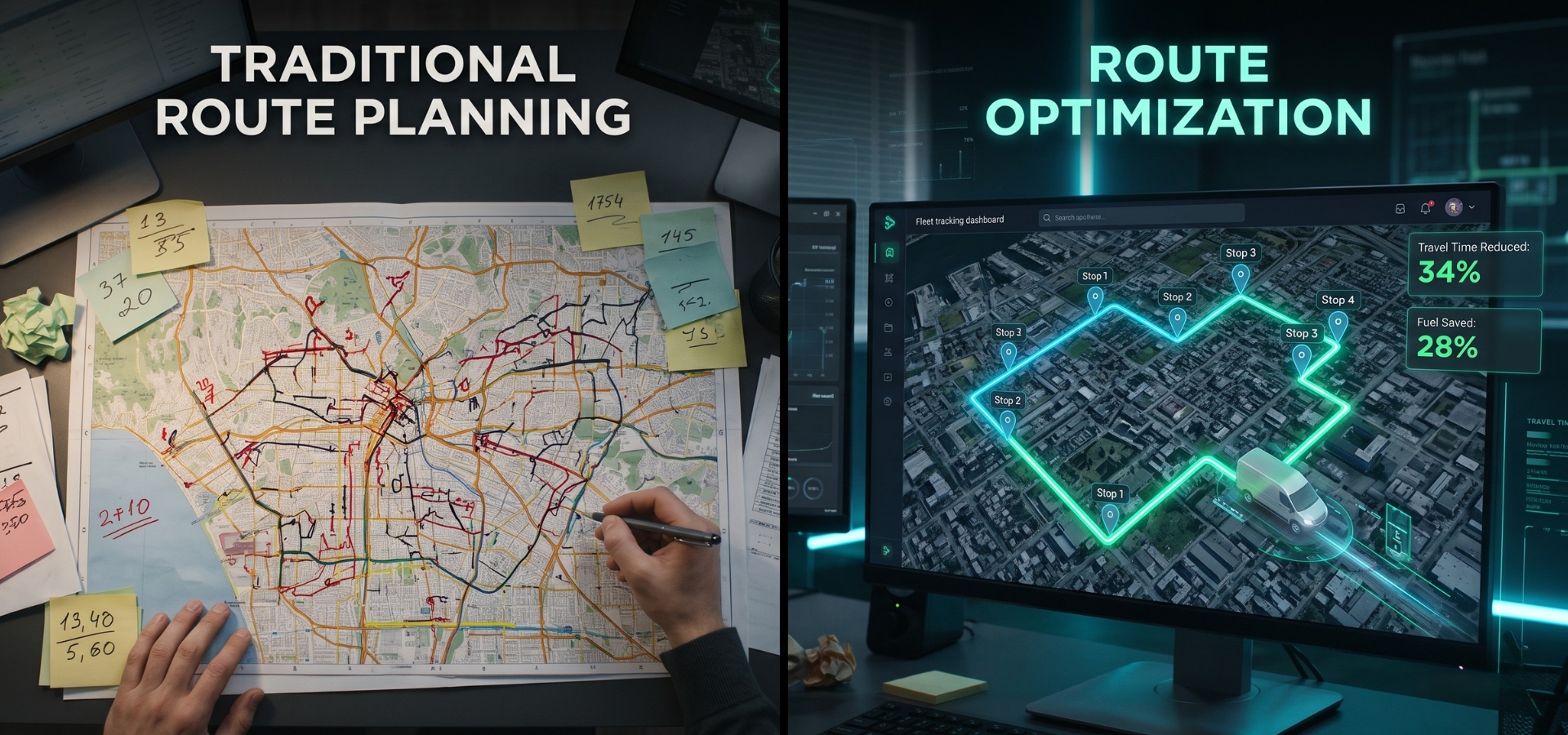
Route planning and route optimization are closely related, but they are not the same.
Route planning involves deciding how a vehicle should travel between locations. Route optimization evaluates different possible plans to identify an efficient way to complete a larger set of delivery or service requirements.
Traditional route planning often relies on dispatcher experience, spreadsheets, maps, and knowledge of familiar delivery areas.
This approach can work well when a business handles a small number of deliveries. However, as the number of orders, vehicles, and constraints increases, comparing every possible route manually becomes increasingly difficult.
Route optimization introduces a more systematic way to evaluate these choices.
Consider a vehicle that must visit eight customers.
A dispatcher might arrange the stops based on geographical proximity. However, this sequence may overlook delivery deadlines, traffic patterns, unloading time, road restrictions, or the location of other vehicles.
An optimized plan evaluates the relevant factors together, subject to the capabilities and data available in the system.
Route planning | Route optimization |
Establishes a route for a journey or set of stops. | Evaluates possible routes and stop sequences against defined objectives. |
May rely heavily on manual decisions and dispatcher experience. | Uses optimization methods to evaluate complex combinations. |
Can become time-consuming as delivery volume increases. | Helps manage larger numbers of orders and operational constraints. |
May focus primarily on distance or geographical proximity. | Can consider time, distance, capacity, delivery windows, and other requirements. |
Often requires manual adjustments when plans change. | Depending on the solution, may support revised plans when conditions change. |
Can be difficult to evaluate consistently across the entire fleet. | Can help measure route efficiency across vehicles and delivery operations. |
Route optimization does not eliminate the value of experienced dispatchers. Instead, it gives them a structured way to evaluate routes, manage constraints, and make informed decisions.
The most effective approach combines optimization with operational knowledge and human oversight.
3. Why Businesses Struggle with Delivery Route Planning
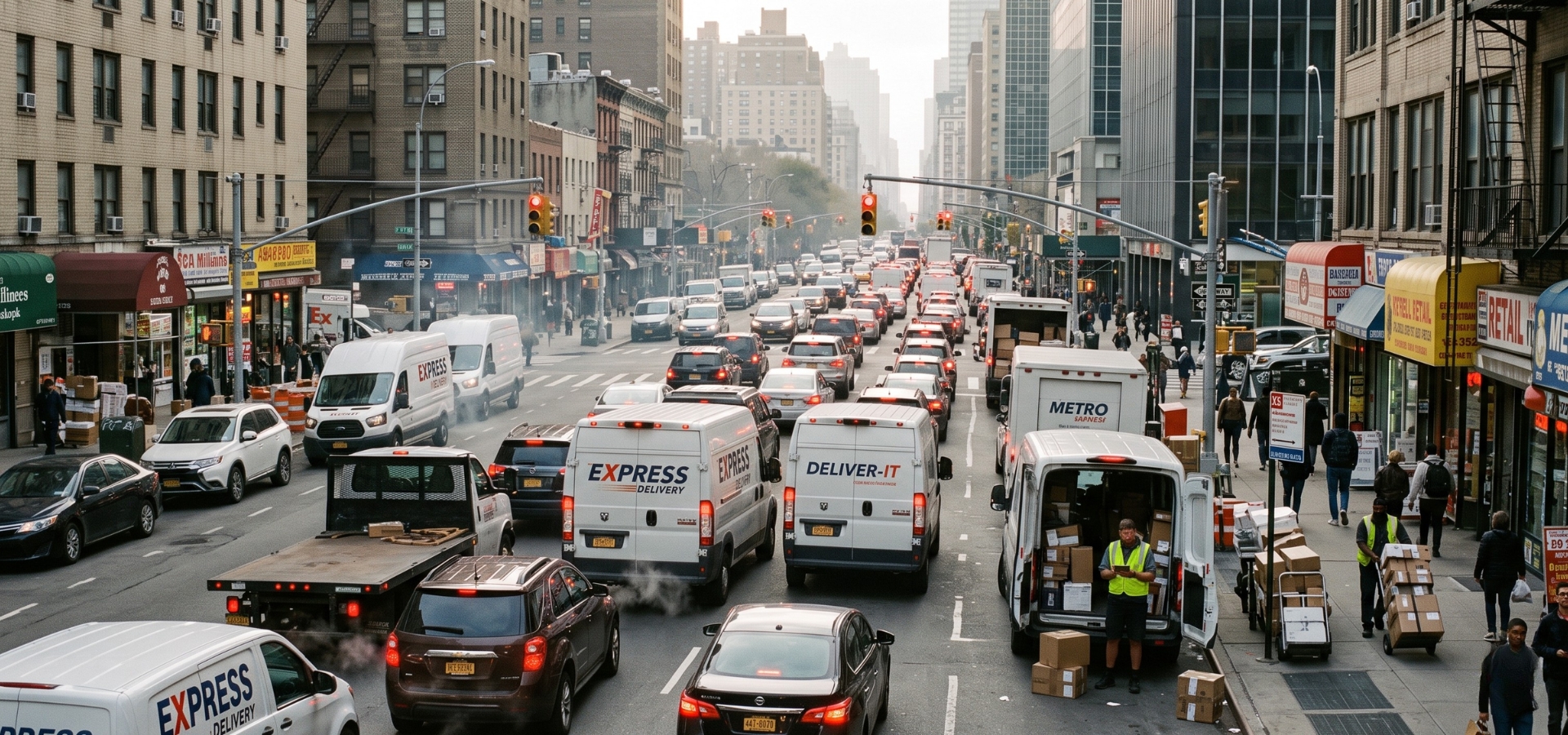
Delivery planning becomes complicated when several operational requirements must be satisfied at the same time.
The challenge is not always a lack of vehicles or drivers. It may be the way deliveries are assigned, sequenced, and coordinated.
3.1 Growing delivery volumes
As order volumes increase, the number of possible route combinations also increases.
A dispatcher who can efficiently plan 10 deliveries may struggle to organize 100 deliveries across several vehicles within the same timeframe.
Every additional stop introduces decisions about assignment, sequence, travel time, capacity, and delivery priority.
Manual planning becomes increasingly difficult to scale without additional time and resources.
3.2 Geographically scattered customers
Customers may be spread across different neighborhoods, industrial areas, business districts, or cities.
If orders are assigned without considering their geographical relationship, vehicles may travel through the same areas unnecessarily or cross paths with one another.
This can increase mileage, fuel consumption, and delivery time.
Route optimization helps businesses evaluate how customer locations can be grouped and sequenced more efficiently.
3.3 Traffic and unpredictable travel times
The shortest geographical distance is not always the quickest journey.
Congestion, roadworks, restricted roads, weather, access limitations, and delivery-area conditions can affect travel time.
A route that appears efficient on a map may be unsuitable at the time the vehicle actually travels.
Travel-time estimates and current traffic information can improve planning where the selected solution supports them, and the necessary data is available.
3.4 Vehicle capacity limitations
Every vehicle has limits on the amount or type of cargo it can carry.
A route may appear efficient because it groups several nearby customers together. However, if their combined orders exceed the vehicle's capacity, the plan cannot be executed as intended.
Vehicle capacity must therefore be considered alongside route distance and delivery sequence.
3.5 Different delivery time windows
Not every customer can receive a delivery at any time.
A retailer may accept goods only before opening hours. A warehouse may schedule unloading appointments. A business customer may require deliveries during a particular operating window.
The route must account for these restrictions.
A geographically efficient route may still fail if it cannot meet the required delivery times.
3.6 Manual dispatching and fragmented information
Delivery information may be spread across Supply Chain Management, spreadsheets, messaging applications, paper documents, and individual employees' knowledge.
When information is fragmented, dispatchers may spend more time collecting and checking data than planning routes.
Missing addresses, outdated delivery instructions, incomplete order details, or unclear priorities can also lead to avoidable delays.
3.7 Last-minute changes
Orders may be cancelled, added, delayed, or reassigned after the initial plan is created.
A customer may change the delivery time, a vehicle may become unavailable, or a driver may report an issue.
Without a structured way to evaluate the effect of these changes, dispatchers may need to rebuild parts of the plan manually.
These challenges demonstrate why route optimization is not simply a mapping exercise. It is a decision-making process that connects delivery requirements, resources, and operational priorities.
4. The Hidden Costs of Poor Route Planning
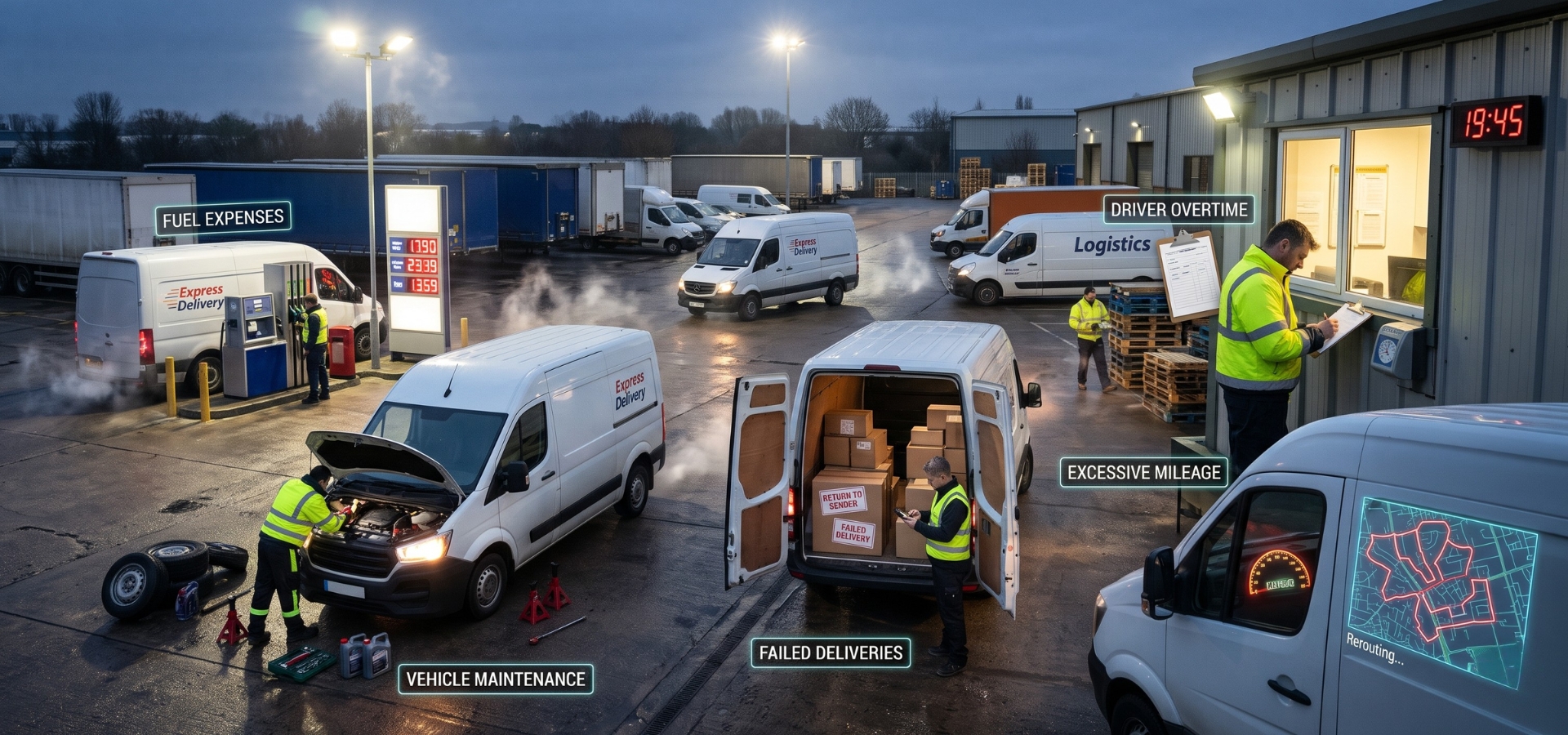
Inefficient route planning can create costs that are not immediately visible in a delivery budget.
Fuel is an obvious expense, but it is only one part of the overall cost.
Excessive fuel consumption
When vehicles travel unnecessary kilometer's, they consume additional fuel. Repeated detours, overlapping routes, and inefficient stop sequences can increase fuel use across the fleet.
Small inefficiencies can become significant when repeated across many vehicles and delivery days.
Higher vehicle maintenance expenses
More distance travelled generally means greater vehicle usage.
Depending on the vehicle and operating conditions, unnecessary mileage can contribute to increased tire wear, servicing requirements, and other maintenance expenses.
A route plan that reduces avoidable travel may help control these costs over time.
Driver overtime
Inefficient routes can extend working hours.
When drivers cannot complete their planned deliveries within the scheduled shift, businesses may incur overtime costs or need additional resources to finish the workload.
The effect can be particularly noticeable during periods of high demand.
Underutilized vehicles
A company may have enough vehicles to complete its deliveries but still use the fleet inefficiently.
Some vehicles may carry relatively small loads while others travel longer distances with a larger workload. Poor assignment decisions can create unnecessary imbalances.
Better route planning can help businesses distribute work more effectively, subject to capacity, geography, and service requirements.
Missed delivery commitments
Late deliveries may lead to customer complaints, additional coordination, redelivery attempts, contractual consequences, or lost future business.
The actual financial impact varies by industry and customer agreement, but delivery reliability is an important operational consideration.
Additional administrative work
Manual planning, route corrections, customer calls, and delivery status checks all consume employee time.
When dispatchers repeatedly resolve avoidable planning problems, they have less time to focus on exceptions, Logistics Management Solutions, and operational improvement.
The cumulative effect
A single inefficient route may seem insignificant. However, the combined effect of unnecessary mileage, overtime, delayed deliveries, underutilized capacity, and repeated manual work can make route planning an important cost-control opportunity.
Route optimization helps businesses identify and address these inefficiencies systematically rather than relying entirely on individual decisions.
5. How Route Optimization Works
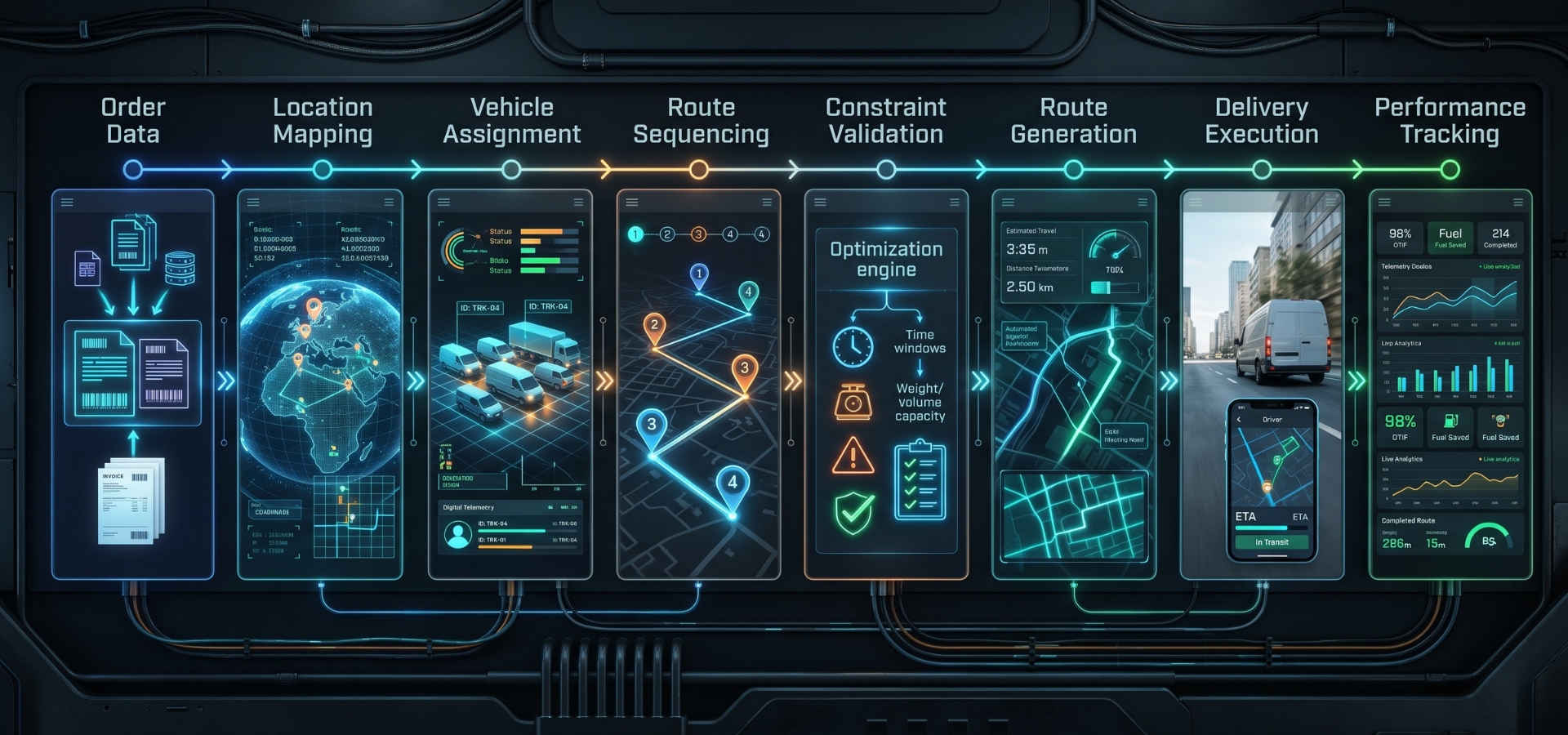
Route optimization follows a structured process that converts delivery requirements into a workable route plan.
The exact workflow depends on the business and the solution, but most route optimization processes involve several common stages.
Step 1: Collect delivery information
The process begins with the information required to plan the deliveries.
This may include:
Customer addresses and delivery locations.
Order quantities and cargo requirements.
Delivery deadlines and time windows.
Vehicle availability and capacity.
Driver availability and working hours.
Warehouse departure and return requirements.
Road restrictions and access limitations.
Delivery priorities and special instructions.
The quality of the output depends on the quality of the information provided.
Incorrect addresses, missing order quantities, or unrealistic delivery times can lead to a plan that looks efficient but cannot be executed successfully.
Step 2: Identify the operating constraints
The system or planning team determines which requirements must be satisfied.
For example, a delivery vehicle may have a maximum capacity for carrying. A customer may need to receive an order before noon. A particular vehicle may be unsuitable for certain roads or cargo types.
Some constraints are mandatory. Others may represent preferences.
A mandatory requirement might be that a vehicle must not exceed it carrying capacity. A preference might be to minimize total travel distance, provided all mandatory requirements are satisfied.
Distinguishing between these requirements is essential to practical route planning.
Step 3: Assign orders to vehicles
The next task is to determine which vehicle should handle each delivery.
This decision may depend on geographical location, capacity, vehicle availability, delivery priorities, and operating schedules.
The objective is to create workable assignments without overloading vehicles or creating unnecessary travel.
In a small operation, the dispatcher may perform this step manually. In a larger operation, an optimization solution can help evaluate possible assignments.
Step 4: Determine the sequence of stops
After assigning deliveries, the next challenge is to determine the order in which each vehicle should visit its destinations.
For example, should a vehicle visit Customer A before Customer B, or would reversing the sequence reduce travel time while still meeting both delivery windows?
The answer depends on the travel time between locations, delivery schedules, expected service duration, and other constraints.
Route optimization evaluates possible stop sequences against the selected objective.
Step 5: Calculate the proposed routes
The system evaluates the route combinations using available distance and travel-time information.
Depending on the solution, it may consider road-network distances, estimated travel times, delivery of windows, vehicle capacity, and other operational constraints.
The purpose is to identify a plan that performs well against the chosen objectives while remaining operationally feasible.
Step 6: Review the plan
An optimized route still needs to make sense in the real operating environment.
Dispatchers may need to review unusual delivery instructions, restricted access, vehicle-specific requirements, or local knowledge that is not represented in the available data.
If a proposed plan is infeasible, the business may need to revise the inputs or relax an appropriate preference.
Mandatory safety, legal, and capacity constraints should not be ignored merely to improve a route score.
Step 7: Communicate routes to drivers
Once the plan is approved, drivers need clear information about their assigned deliveries and stop sequences.
Depending on the operational setup, this information may be communicated through a delivery application, fleet platform, dispatch system, or other established processes.
Clear communication reduces ambiguity and helps drivers execute the plan consistently.
Step 8: Track execution and measure performance
After dispatching, the business can compare planned routes with actual performance.
Useful measurements include completed deliveries, actual distance travelled, delivery punctuality, vehicle utilization, and deviations from the original plan.
This information helps identify recurring problems and improve future planning.
The process should not end when the route is generated. Continuous measurement is necessary to understand whether route optimization is delivering meaningful operational improvements.
6. Key Factors Considered in Route Optimization

An efficient route depends on more than the number of kilometers between stops.
A practical route optimization solution may consider several factors together.
Distance
Distance affects fuel consumption, vehicle usage, travel time, and maintenance requirements.
Reducing unnecessary kilometer's can improve operational efficiency, but the shortest route is not necessarily the best route if it creates missed deadlines or other problems.
Travel time
Travel time is especially important when deliveries must be completed within defined schedules.
Two routes of similar distance may require different travel times because of traffic conditions, road types, access restrictions, or expected delays.
Delivery time windows
Time windows specify when a delivery should take place.
A route needs to consider not only the distance between stops but also when each customer can receive the order.
Vehicle capacity
Capacity constraints prevent the plan from assigning more cargo than a vehicle can carry.
Depending on the operation, capacity may involve weight, volume, available space, pallet positions, or other measures.
Vehicle suitability
Some deliveries require specific vehicle types or equipment.
The planning process must account for those requirements where relevant.
Driver availability
Routes must fit within available driver schedules and applicable working-hour restrictions.
A plan that requires a driver to work beyond permitted or practical limits is not a suitable operational plan.
Service time at each stop
Delivery time includes more than driving.
Drivers may need time to find the customer entrance, unload goods, obtain a signature, complete documentation, or wait for an unloading bay.
Ignoring service time can make a route appear feasible when the actual schedule is unrealistic.
Delivery priority
Some deliveries are more time-sensitive than others.
Priority rules can help businesses protect critical deliveries while organizing the remaining workload efficiently.
Road restrictions and access requirements
Vehicle height, weight, road-access restrictions, restricted delivery zones, and site-specific requirements may affect the routes that can be used.
The available solution and routing data must support the relevant restrictions for them to be considered reliably.
Starting and ending locations
Some vehicles begin and end at the same depot. Others may start from different locations or finish at a different approved destination.
These requirements influence route design and vehicle assignments.
The best route plan balances these factors according to the business's priorities and operating constraints.
7. How Route Optimization Helps Reduce Delivery Time
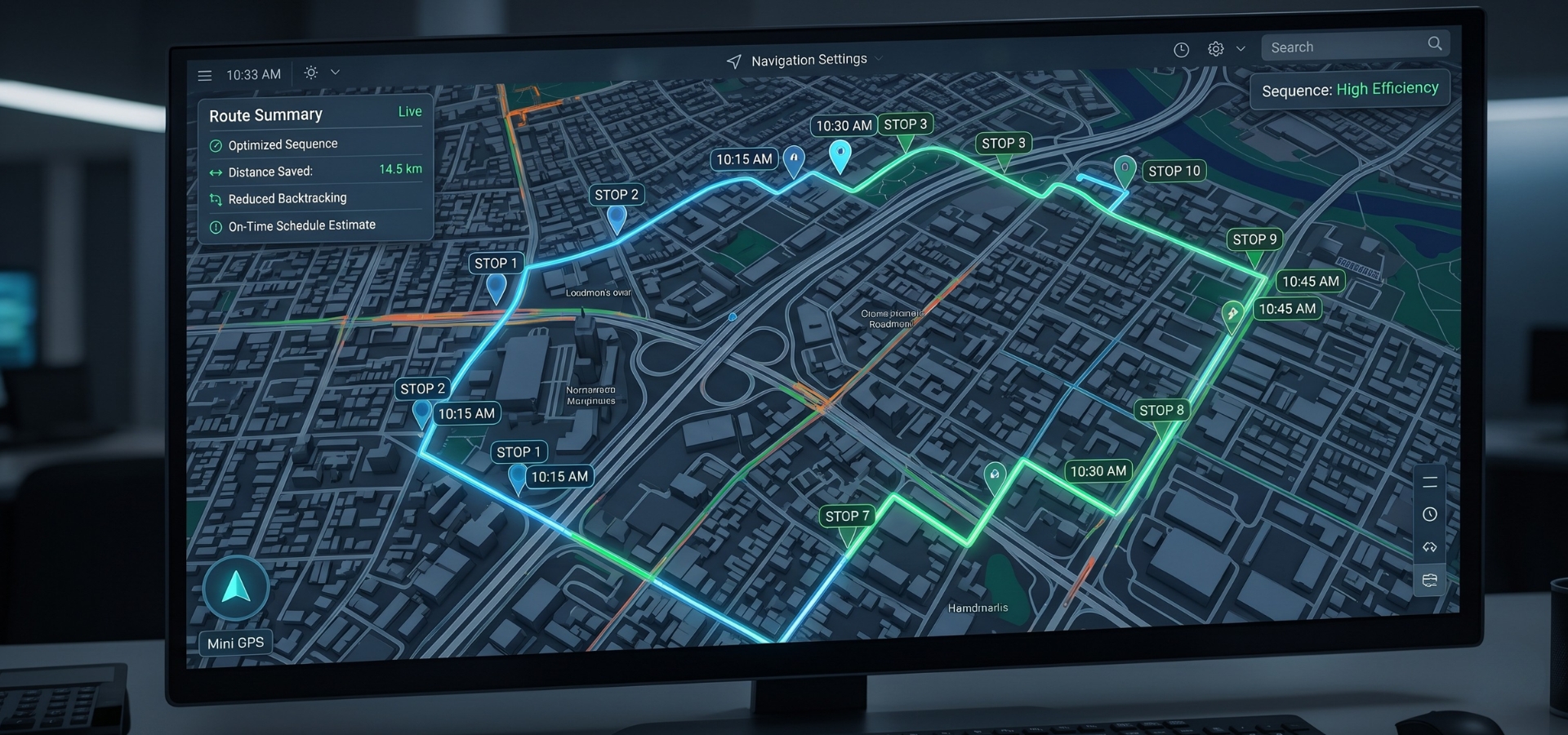
Reducing delivery time is one of the most important reasons businesses consider route optimization.
The improvement does not necessarily come from making every individual journey faster. It often comes from organizing the entire delivery operation more effectively.
7.1 Reducing unnecessary travel
When stops are arranged inefficiently, vehicles may cross the same areas repeatedly or travel away from nearby customers before returning to them.
Route optimization evaluates stop sequences to reduce avoidable travel where possible.
Less unnecessary travel can create more time for completing deliveries.
7.2 Improving the sequence of deliveries
The order in which customers are visited can significantly affect route performance.
Suppose a vehicle must deliver goods to several customers located in different parts of the city. Visiting the destinations in an arbitrary order may create repeated backtracking.
A more efficient sequence can reduce travel time while respecting customer schedules and other constraints.
7.3 Reducing unnecessary overlap between vehicles
When multiple vehicles operate in the same region, poor assignment decisions may cause them to cover overlapping areas unnecessarily.
Route optimization can help distribute deliveries across vehicles more effectively.
The objective is not to eliminate all overlaps. Some overlap may be necessary because of capacity, delivery deadlines, or vehicle availability. The goal is to avoid unnecessary duplication.
7.4 Improving delivery scheduling
Route optimization helps businesses evaluate whether planned routes can accommodate delivery of windows and service durations.
By identifying scheduling conflicts before dispatching, the business can revise assignments or delivery sequences instead of discovering problems after the vehicle is already on the road.
7.5 Reducing delays caused by unrealistic plans
A route that assumes every stop can be completed immediately is unlikely to reflect actual operating conditions.
Realistic service-time estimates, driver schedules, and travel-time data help create more achievable delivery plans.
A feasible plan is often more valuable than an apparently faster route that repeatedly fails during execution.
7.6 Making better use of the available fleet
When deliveries are assigned more effectively, businesses may be able to complete the planned workload with fewer unnecessary journeys or less duplicated effort.
Whether this reduces the total number of vehicles required depends on the operation volume, peak demand, service commitments, and other constraints.
7.7 Supporting faster planning when order volumes grow
Manual planning time can increase as the number of deliveries rises.
Route optimization can help dispatchers evaluate complex delivery combinations more systematically, allowing planning processes to handle greater complexity without relying exclusively on manual calculations.
The resulting time savings depend on the existing process, data quality, and implementation.
8. How Route Optimization Helps Reduce Operational Costs
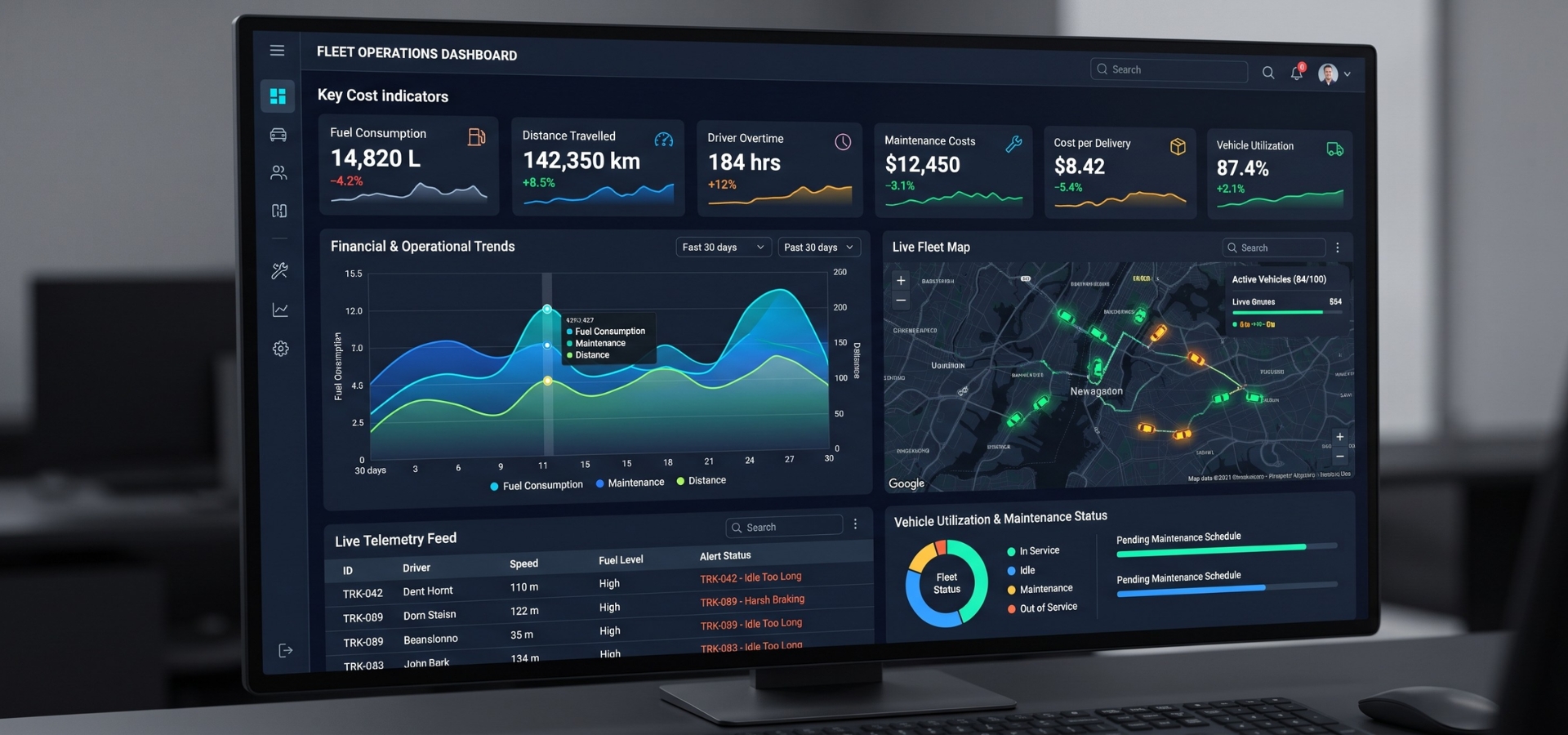
Route optimization can support cost reduction by improving the use of vehicles, fuel, labor, and delivery of resources.
The benefits vary by business, so companies should measure results against their own operating baseline rather than assume a fixed percentage of savings.
8.1 Lower fuel costs
Fuel consumption is influenced by distance, traffic, vehicle type, driving conditions, load, and driver behaviors.
Reducing avoidable kilometer's can help reduce fuel consumption, particularly when the improvement is sustained across many routes.
However, fuel savings should be measured using actual operating data. A shorter route does not always consume less fuel if it involves heavy congestion, frequent stopping, or unsuitable roads.
8.2 Better control of driver overtime
When routes are planned realistically, drivers may be more likely to complete their scheduled work within their assigned shifts.
This can help reduce avoidable overtime caused by inefficient stop sequences or unrealistic delivery schedules.
Businesses must still account for loading, unloading, traffic, breaks, and unexpected delays.
8.3 More effective fleet utilization
A business may own or lease vehicles that are not used evenly.
Some vehicles may operate near capacity while others complete relatively small workloads. Other routes may require unnecessary additional trips because orders were not assigned effectively.
Route optimization can help businesses evaluate vehicle assignments and distribute work more appropriately.
Improved utilization may reduce the need for avoidable trips or additional capacity, depending on the operating conditions.
8.4 Reduced vehicle wear and maintenance pressure
Unnecessary travel adds mileage and vehicle usage.
Where route optimization consistently reduces avoidable distance, it may help control mileage-related maintenance requirements over time.
Actual savings depend on vehicle condition, driving environment, maintenance practices, and the nature of the routes.
8.5 Fewer failed or repeated delivery attempts
An unsuccessful delivery can create additional work.
The vehicle may need to return later, the order may need to be reassigned, or the business may need to coordinate a new delivery window.
Accurate scheduling and better route planning can help reduce failures caused by poor sequencing or unrealistic arrival estimates.
Route optimization cannot eliminate failures caused by unavailable customers, incorrect addresses, damaged goods, or other unrelated issues. Those problems require their own control.
8.6 Lower administrative effort
Dispatchers often spend time assigning orders, rearranging stops, comparing routes, and communicating changes.
A suitable route optimization solution can help organize these decisions and reduce repetitive manual work.
The value is not limited to labour savings. It can also allow employees to spend more time on exception management, customer service, and process improvement.
8.7 Better planning for peak demand
Demand may fluctuate during weekends, holidays, seasonal periods, promotional campaigns, or industry-specific peaks.
Route optimization helps businesses evaluate how delivery requirements can be distributed across available resources.
This can improve planning discipline when workloads change, although major capacity shortages may still require additional vehicles, drivers, or delivery windows.
8.8 More informed transportation decisions
Historical route data and operational performance measurements can help managers identify where costs originate.
For example, a business may discover that certain delivery zones consistently require more travel time; that schedules generate overtime, or that some vehicles are regularly underutilized.
These findings can support better decisions about delivery of territories, schedules, fleet capacity, and service policies.
9. Route Optimization and Fleet Utilization
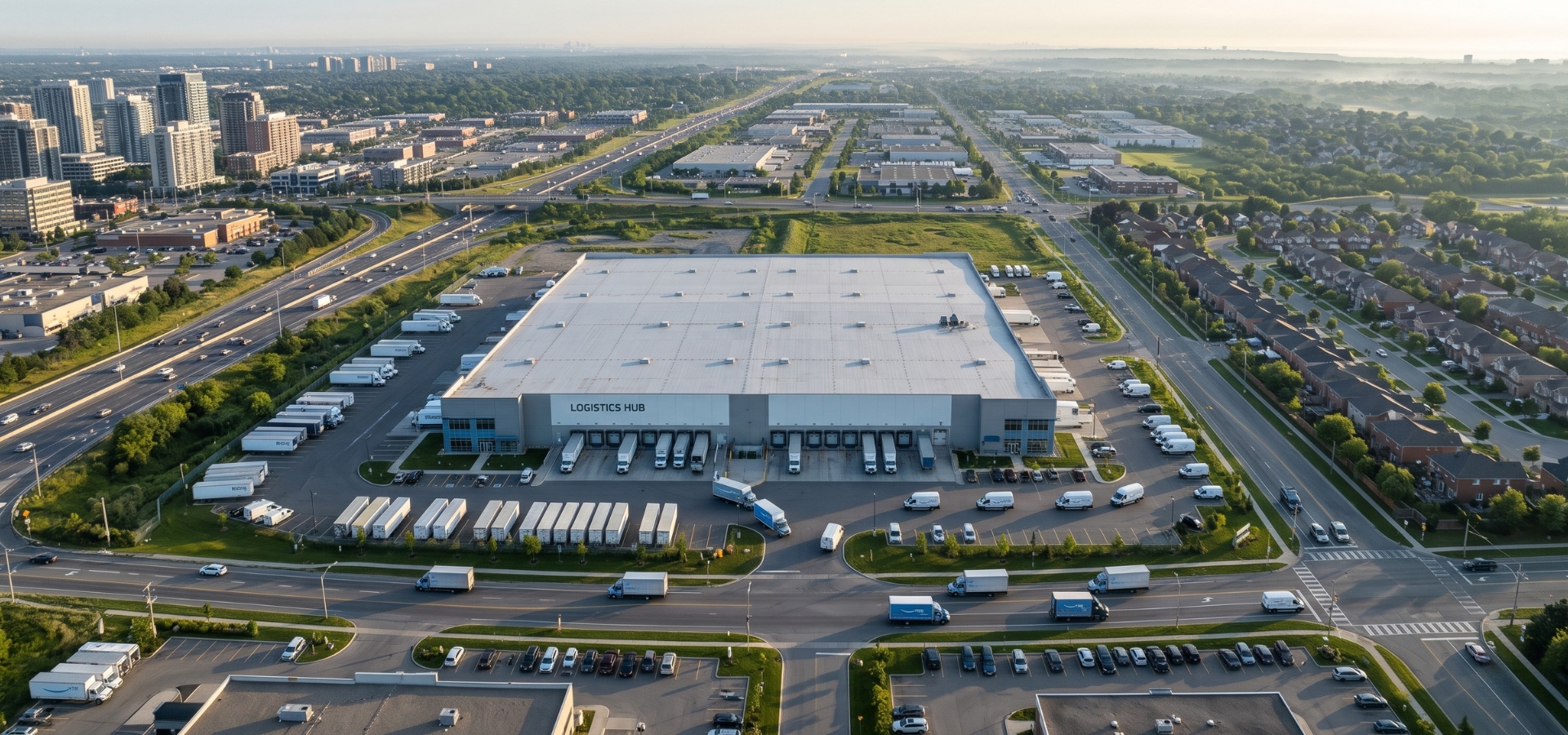
Fleet utilization describes how effectively a business uses its available vehicles to complete operational work.
A fleet can be large enough to handle demand and still be inefficiently managed.
One vehicle might travel a long distance with only a small number of deliveries, while another vehicle covers a similar area unnecessarily. Alternatively, a vehicle may be fully loaded but assigned a route that makes it difficult to meet delivery commitments.
Route optimization can help businesses balance workload and vehicle use by evaluating assignments alongside route requirements.
Better allocation of delivery orders
Orders can be grouped and assigned according to geographical location, capacity, delivery windows, and vehicle availability.
This helps avoid decisions based only on which vehicle or driver happens to be available first.
unnecessary trips
If compatible orders can be combined within a vehicle's capacity and schedule, businesses may be able to reduce separate journeys.
This requires careful planning because combining orders is not always appropriate. Delivery deadlines, cargo restrictions, and customer requirements must take priority.
More balanced workloads
A route plan can help distribute work across vehicles rather than leaving one driver with an unrealistic workload while another has excess capacity.
Balanced workloads can improve scheduling and make daily operations easier to manage.
More effective capacity planning
Delivery Performance Analytics can reveal how much work the fleet handles under different demand conditions.
Businesses can use this information to understand whether their current fleet is sufficient, whether additional capacity is required during peak periods, or whether operational inefficiencies are making the fleet appear smaller than it needs to be.
Route optimization does not automatically eliminate the need for vehicles. It helps management make more informed decisions about how available capacity is used.
10. Route Optimization for Multiple Vehicles
Single-vehicle routing is relatively straightforward: determine a suitable sequence of stops for one vehicle.
Multi-vehicle route optimization introduces another layer of complexity.
The business must decide which vehicle should handle each delivery and determine the sequence of stops for every assigned route.
These decisions affect one another.
Assigning an order to one vehicle changes the remaining workload for other vehicles. A delivery that fits geographically into one route may be more suitable for another vehicle because of capacity, timing, or vehicle-specific requirements.
A multi-vehicle planning process may consider:
The number of vehicles is available.
Vehicle carrying capacities.
Customer locations and delivery windows.
Starting and ending depots.
Driver schedules.
Order priorities.
Route distance and travel time.
Vehicle-specific restrictions.
The required delivery completion time.
The aim is to find a practical balance across the fleet.
An illustrative example
Imagine a distributor with four vehicles and 40 delivery orders spread across a city.
A manual approach might divide the orders into four groups based on geographical areas. This is a reasonable starting point, but the groups may not have balanced workloads.
One area may contain many small deliveries, while another has a few large orders with longer unloading times. Some customers may require morning delivery, while others accept deliveries throughout the day.
Route optimization can help evaluate vehicle assignments and stop sequences while considering these differences.
The resulting plan may divide the orders differently from a simple geographical grouping. The most appropriate allocation depends on the actual data and operational constraints.
This example is illustrative, not a claim about a specific customer deployment or guaranteed outcome.
11. Route Optimization and Delivery Time Windows
Delivery time windows specify the period during which a customer expects or permits a delivery.
They are common in retail distribution, business-to-business logistics, food delivery, industrial supply, and warehouse replenishment.
Time windows complicate route planning because a vehicle cannot always visit the geographically nearest customer first.
For example, a customer located farther away may require a delivery before 10:00 AM, while a nearby customer can receive the order at any time before the end of the day.
A route that visits the nearby customer first may cause the earlier deadline to be missed.
Route optimization helps businesses evaluate the sequence of stops against the required delivery windows.
Why time-window planning matters
Customer satisfaction: Meeting agreed delivery times supports a more dependable service experience.
Warehouse coordination: Some customers have specific receiving schedules or unloading appointments.
Driver scheduling: A realistic plan helps drivers organize their work around expected arrival and service times.
Reduced waiting: Scheduling can help avoid arriving at locations when deliveries cannot be accepted, provided opening hours and receiving restrictions are available.
Better exception management: Identifying conflicts before dispatch gives the business an opportunity to revise the plan.
Time windows can be difficult to satisfy when there are too many deliveries, insufficient vehicles, excessive travel times, or conflicting restrictions.
A route optimization system should make these constraints visible rather than assume every requested delivery schedule can be met.
12. Route Optimization and Last-Mile Delivery
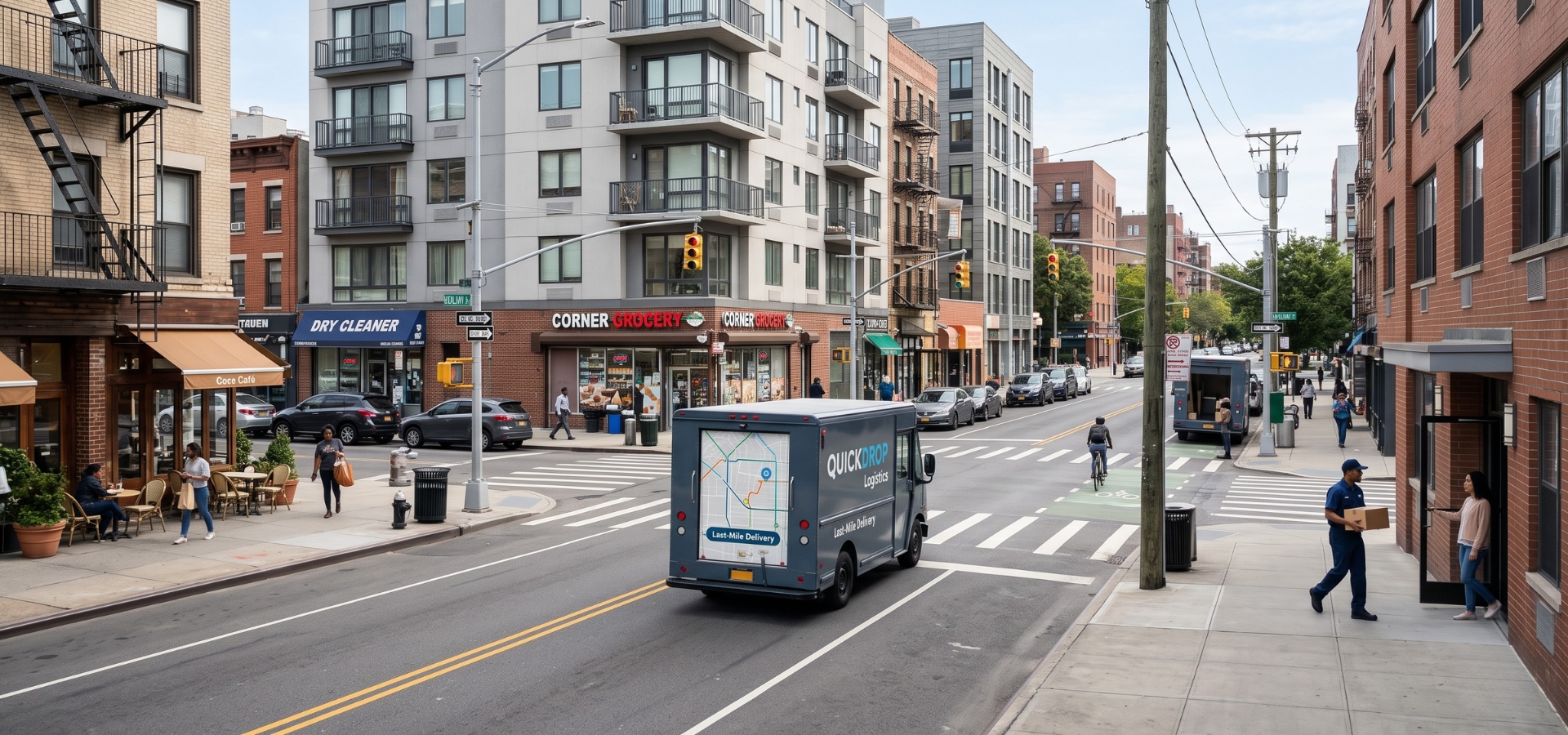
Last-mile delivery refers to the final stage of transporting goods from a distribution center, store, local hub, or other dispatch point to the customer.
It is often one of the most operationally challenging parts of delivery because vehicles must handle many individual destinations, different customer requirements, and changing local conditions.
A relatively short geographical area can still contain a large number of stops.
Urban deliveries may involve congestion, parking limitations, access restrictions, security procedures, and buildings where unloading takes considerable time.
Challenges in last-mile delivery
High numbers of individual delivery stop.
Different customer availability windows.
Congested or restricted delivery areas.
Incomplete or inaccurate addresses.
Variable unloading and handover times.
Failed deliveries and customer rescheduling.
High expectations for delivery punctuality.
Frequent changes in order volume.
How route optimization helps
Route optimization helps businesses group and sequence deliveries in ways that account for the relevant constraints.
It can support more efficient assignment of orders, reduce unnecessary backtracking, and help planners create routes that better match the expected workload.
For businesses that manage multiple delivery vehicles, optimization can also help reduce unnecessary overlap between routes.
Why last-mile efficiency matters
The final delivery stage affects both cost and customer experience.
An inefficient route may increase fuel use and driver hours. A poorly scheduled delivery may inconvenience a customer or require another delivery attempt.
Improving route planning can help businesses control these problems, although successful last-mile operations also depend on accurate addresses, order fulfilment, communication, and reliable execution.
13. Route Optimization Across Different Industries

Route optimization is relevant wherever vehicles must visit multiple locations, and businesses need to coordinate time, distance, resources, and service requirements.
The exact objectives vary by industry.
13.1 Retail and e-commerce
Retailers and e-commerce businesses often manage large numbers of customer deliveries across multiple neighborhoods.
Demand may fluctuate with promotional campaigns, seasonal sales, and changing customer expectations.
Route optimization can help businesses organize delivery sequences, allocate orders across available vehicles, and plan workloads more efficiently.
For retailers operating both store replenishment and customer delivery services, route planning may also help coordinate different types of delivery requirements.
13.2 Logistics and distribution
Logistics providers must coordinate consignments, vehicles, delivery schedules, and customer requirements.
Route optimization can support more efficient vehicle assignments and delivery of sequencing across distribution operations.
The value becomes especially relevant when a company manages many stops, different vehicle capacities, and time-sensitive customer commitments.
13.3 Freight forwarding
Freight forwarding operations can involve collections, warehouse transfers, port-related movements, and final delivery activities.
Not every freight forwarding activity can be treated as a simple multi-stop delivery route. Some movements depend on shipment consolidation, terminal schedules, customs processes, and other operational requirements.
Where vehicles need to visit multiple collection or delivery points, route optimization can help organize those journeys around available schedules and capacity.
13.4 Food and beverage distribution
Food and beverage distributors may serve supermarkets, restaurants, hotels, retailers, and other business customers.
Deliveries may be time-sensitive and may require specific vehicle conditions or handling procedures.
Route optimization can help arrange customer visits while considering delivery windows, vehicle capacity, and unloading time.
For temperature-sensitive products, the routing plan must also respect relevant handling and time requirements. A shorter route should never take precedence over product safety or mandatory operating constraints.
13.5 Manufacturing and industrial supply
Manufacturers may need raw materials, components, spare parts, and finished goods moved between factories, warehouses, suppliers, and customers.
Route optimization can support vehicle scheduling for compatible collection and delivery activities.
It may also help businesses organize internal or regional transportation tasks where multiple stops must be completed within a planned shift.
13.6 Field service operations
Field service businesses send technicians to customer sites to install equipment, inspect assets, perform maintenance, or resolve technical problems.
Although technician scheduling differs from goods of delivery, the route-planning principles are related.
A service operation must consider technician availability, job duration, appointment windows, location, skills, and travel time.
Route optimization can help organize site visits and reduce unnecessary travel when these requirements are supported by the scheduling solution.
13.7 Healthcare and medical logistics
Healthcare logistics may involve medical supplies, laboratory samples, equipment, and other time-sensitive materials.
Route planning can help organize collections and deliveries, but healthcare operations may have strict handling, temperature, security, and chain-of-custody requirements.
Any optimization process must account for those requirements. Delivery speed alone is not an adequate measure of success.
13.8 Waste collection and recycling
Waste collection operations may involve numerous collection points, different vehicle capacities, restricted access, and disposal or transfer locations.
Route optimization can help plan collection sequences and vehicle assignments around these constraints.
The actual route plan must also consider collection schedules, operating permissions, safety requirements, and facility availability.
13.9 Courier and parcel delivery
Courier businesses handle many individual deliveries, often with a mix of residential and commercial destinations.
Route optimization can help organize parcel distribution, balance workloads, and improve the sequence of stops.
The value is particularly relevant when delivery volumes fluctuate, and the operation must handle many destinations within a limited working day.
Across these industries, the central objective remains the same: coordinate delivery requirements and available resources to create practical, efficient routes.
14. Route Optimization as Part of Supply Chain Management
Route optimization is one component of a broader supply chain operation.
A delivery plan depends on more than road networks and vehicle availability. It also depends on when orders are ready, where inventory is located, how goods are packed, and what customers have been promised.
If the warehouse prepares an order late, even a well-optimized route may not be left on schedule.
If an order contains incorrect quantities, the delivery may require a correction or a second journey.
If the dispatch team does not receive accurate delivery information, the route may be planned around incomplete requirements.
This is why route optimization should be considered in the context of the wider supply chain.
Connecting delivery planning with order information
Accurate order details help the planning team understand what must be delivered, where it needs to go, and when it must arrive.
When businesses can make reliable order information available to the route-planning process, they can reduce the need to re-enter details manually and improve planning consistency.
Coordinating warehouse operations
The timing of picking, packing, staging, and loading affects vehicle departure schedules.
A route plan should reflect realistic loading and dispatch requirements.
Businesses may need to coordinate route sequencing with warehouse cut-off times so that vehicles can leave with the correct orders at the intended time.
Aligning inventory and transportation
Product availability affects delivery commitments.
If goods are unavailable when a route is being prepared, the business may need to revise the order, change the delivery schedule, or arrange a later dispatch.
Better coordination between inventory information and transportation planning can help prevent avoidable disruption.
Supporting operational visibility
Managers need to understand whether orders are ready, routes have departed, deliveries have been completed, and exceptions require action.
The specific visibility available depends on the systems a business uses and how those systems exchange information.
Route optimization becomes more useful when it operates within a clear process for preparing, dispatching, executing, and reviewing deliveries.
15. Understanding the Vehicle Routing Problem
The Vehicle Routing Problem, commonly called VRP, is a well-known optimization problem in logistics and transportation.
It involves determining suitable routes for a fleet of vehicles that must serve a set of locations while satisfying defined requirements.
A basic version of the problem may involve one depot, several customers, and multiple vehicles.
The objective might be to minimize total distance traveled while ensuring that every customer is visited and vehicle capacity is respected.
Real-world versions can be more complicated.
They may include delivery time windows, driver schedules, different vehicle types, multiple depots, collection tasks, road restrictions, and priorities.
Why the problem becomes complex
As the number of customers increases, the number of possible visit sequences and vehicle assignments can grow rapidly.
For even a relatively small delivery operation, manually evaluating every possible combination is impractical.
Optimization algorithms help search through possible solutions more systematically.
The aim is to find a feasible solution that performs well against selected objectives.
Common types of vehicle routing problems
Capacitated Vehicle Routing Problem: Vehicles have capacity limits that must be respected.
Vehicle Routing Problem with Time Windows: Customers must be served within specified time periods.
Multi-Depot Vehicle Routing Problem: Vehicles may depart from multiple depots or distribution center's.
Pickup and Delivery Problem: Vehicles collect items from some locations and deliver them to others, subject to relevant requirements.
Dynamic Vehicle Routing Problem: New information or changing conditions may require routes to be revised during the planning or execution process.
These categories help explain why different businesses need different route optimization capabilities.
A solution suitable for a small distributor may not be sufficient for a business operating several depots, handling collections and deliveries, or managing strict appointment schedules.
Understanding the actual routing problem is therefore an important step when selecting a solution.
16. How Route Optimization Algorithms Work in Practical Terms
Route optimization software uses mathematical methods and algorithms to evaluate possible routing decisions.
The precise techniques vary between solutions, and the implementation details may not be visible to the end user.
However, the general process can be understood without advanced mathematics.
Representing the delivery network
The system needs information about the depot, delivery locations, and travel connections between them.
For each relevant pair of locations, it may use estimated distance or travel time.
This information can be represented as a distance or travel-time matrix.
For example, the matrix may estimate how long it takes to travel from warehouse to Customer A, from Customer A to Customer B, and from Customer B to Customer C.
The estimates should reflect the available routing data and may need adjustment for traffic, time of day, vehicle restrictions, or other conditions.
Defining the objective
Before a route can be optimized, the business must determine what it wants to improve.
Possible objectives include:
Minimizing total distance.
Reducing estimated travel time.
Minimize the number of vehicles required for the planned workload.
Reducing transportation costs.
Improving delivery punctuality.
Balancing workloads across vehicles.
These objectives can conflict.
For example, minimizing the number of vehicles might produce longer routes or more demanding schedules. Minimizing distance might result in a route that does not meet a customer's preferred delivery time.
The objective must therefore reflect the business's actual operating priorities.
Applying constraints
The system then considers requirements that a valid plan must be respected.
These may include vehicle capacity, driver availability, delivery time windows, starting locations, and vehicle suitability.
Constraints help distinguish a genuinely workable route from a route that is mathematically attractive but operationally impossible.
Searching for suitable solutions
The algorithm evaluates route possibilities and looks for plans that perform well against the objective.
Some routing problems can be solved in exactly manageable sizes. Larger or more complex problems may require heuristic or metaheuristic approaches that search for high-quality solutions without exhaustively evaluating every possibility.
The method depends on the size and structure of the problem, the required response time, and the solution's design.
Producing an operational plan
The result is a proposed set of vehicle assignments and stops sequences.
Depending on the solution, it may include route distances, estimated arrival times, or other planning information.
The business should still review the plan for operational feasibility and ensure that the assumptions used by the system match real working conditions.
The purpose of the algorithm is not to replace operational judgments. It is to make complex routing decisions more manageable.
17. Static and Dynamic Route Optimization
Route optimization can be performed before vehicles depart or revised as new information becomes available.
These approaches are often described as static and dynamic route optimization.
Static route optimization
Static route optimization creates a plan using the information available at a particular planning point.
For example, a distributor may collect the next day's orders, confirm vehicle availability, and generate routes before the morning dispatch.
This approach is suitable when most delivery requirements are known in advance, and the operation does not need frequent route changes.
Its effectiveness depends on how accurately the original information reflects the actual delivery day.
Dynamic route optimization
Dynamic route optimization considers changes that occur after planning begins.
A new order may arrive; a vehicle may become unavailable, or an existing delivery may be delayed.
Depending on the solution, the system may support recalculating affected routes or evaluating revised assignments when new information becomes available.
Dynamic optimization requires reliable and timely information about the changes that matter to the operation.
It also needs clear rules about which changes to justify replanning.
When should a business use each approach?
A business with predictable deliveries and fixed customer schedules may be well served by a planned daily routing process.
An operation that receives frequent new orders or experiences substantial changes during the delivery day may benefit from more flexible planning capabilities.
Some businesses use a combination: they optimize routes before dispatching and make selected changes when important exceptions occur.
The correct approach depends on order volatility, service commitments, data availability, and the cost of changing an existing plan.
Frequent replanning is not automatically better. Route changes can create confusion for drivers, warehouses, and customers if they are not communicated properly.
18. Reverse Logistics, Returns, and Collection Routes
Delivery operations do not always involve transporting goods from a warehouse to a customer.
Vehicles may also collect returns, retrieve reusable packaging, collect materials from suppliers, or transport goods back to a distribution Centre.
These activities are part of reverse logistics and collection planning.
Why collections complicate routing
A vehicle may need to deliver products to several customers and collect items from selected locations on the same journey.
The plan must account for the sequence of both delivery and collection tasks.
Vehicle capacity may also change during the route. A vehicle could begin with a full load, deliver goods at several stops, and then collect returned products.
The route must consider the amount of available capacity at the relevant stages of the journey.
Planning returns and collections
A suitable routing process can help businesses group compatible collection tasks, coordinate pickup windows, and reduce unnecessary journeys.
For example, a distributor may need to collect reusable crates from customers during scheduled deliveries. Combining the activities may reduce the need for separate collection trips, provided the vehicle has sufficient capacity, and the timing is practical.
Why reverse logistics deserves attention
Returns and collections can create substantial operational work when they are planned separately from outbound deliveries without considering opportunities for coordination.
Route optimization can help businesses evaluate whether compatible activities can be combined more efficiently.
The appropriate approach depends on the nature of the goods, handling requirements, vehicle capacity, customer schedules, and the business's return policies.
19. Peak Demand, Seasonal Changes, and Order Cut-Offs
Delivery requirements rarely remain identical throughout the year.
Retail promotions, holidays, seasonal purchasing patterns, weather-related demand, and changes in customer activity can increase or redistribute order volumes.
A route plan that works well on a normal weekday may not work during a high-demand period.
The challenge of peak demand
During busy periods, businesses may need to complete more deliveries within the same operating hours.
This can create pressure on vehicle capacity, driver availability, warehouse preparation, and delivery schedules.
Manual planning becomes more difficult when the number of possible assignments and routes increases.
How route optimization supports peak planning
Route optimization can help businesses evaluate how orders should be distributed across available vehicles and delivery periods.
It can also help identify when the planned workload exceeds the practical capacity of the current fleet.
This distinction is important. Optimization can improve the use of available resources, but it cannot always compensate for a genuine shortage of vehicles, drivers, or operating hours.
The role of order cut-off times
Order cut-off times determine when orders must be received to qualify for a particular delivery schedule.
If an order arrives after the planning cut-off, the business may need to decide whether to include it in an existing route, schedule it for a later period, or arrange a separate delivery.
These decisions affect both cost and customer experience.
A clear cut-off policy helps the planning team avoid constant route changes that undermine delivery efficiency.
Scenario planning
Businesses can review historical order patterns and evaluate how different demand levels might affect their delivery operations.
For example, they may compare a normal day with a peak day to understand whether the available fleet can meet the expected workload.
This supports more informed decisions about temporary capacity, delivery windows, and operational preparation.
20. Route Optimization, Real-Time Tracking, and Telematics
Route optimization, vehicle tracking, and telematics are related but distinct capabilities.
Route optimization determines a suitable delivery plan. Vehicle tracking provides information about vehicle location. Telematics can provide additional information about vehicle activity and operating conditions, depending on the system installed.
When these capabilities are available and connected appropriately, they can support better delivery management.
The role of vehicle tracking
Vehicle location information can help dispatchers understand whether a vehicle is following its expected journey and whether a delivery may be delayed.
It may also support communication with customers and coordination across the fleet.
However, tracking a vehicle does not automatically optimize its route. Tracking and optimization solve different problems.
The role of telematics
Telematics systems may collect information such as vehicle movement, mileage, idling, or driving behavior.
Businesses can use relevant data to understand operational performance and identify opportunities for improvement.
The information available depends on the vehicle, installed equipment, software, and configuration.
Combining planning with execution data
When planned routes can be compared with actual vehicle activity, managers gain a clearer understanding of how well the delivery plan is performed.
They can investigate differences between estimated and actual travel times, identify recurring delays, and review whether the original assumptions were realistic.
This information can improve future planning.
Handling changing conditions
Some route optimization solutions can support route updates based on new information, but the availability and timing of such updates vary.
Businesses should confirm which real-time inputs a solution can use, and how route changes are communicated before relying on dynamic replanning.
21. Data Quality and System Integration
Route optimization is only as useful as the information on which it depends.
A sophisticated algorithm cannot consistently generate practical routes when addresses are inaccurate; order quantities are missing, or delivery restrictions are recorded incorrectly.
Data quality should therefore be treated as a core part of route optimization, not as a minor technical detail.
Accurate customer addresses
Incomplete or incorrect addresses can cause drivers to waste time finding destinations or travel to the wrong location.
Businesses should establish a process for validating addresses and maintaining accurate delivery instructions.
Where appropriate, location data should be checked before the order enters the routing process.
Reliable order information
The routing process may need to know the number of items, their weight or volume, handling requirements, and delivery deadlines.
If this information is missing, the system may assign orders incorrectly or create routes that exceed vehicle capacity.
Up-to-date vehicle information
Vehicle availability and capacity need to reflect actual operating conditions.
A vehicle undergoing maintenance should not be treated as available. A vehicle with restricted capacity should not be planned as though it can carry a full load.
Realistic service-time estimates
Service time at each stop affects whether a route can be completed within the planned schedule.
Businesses should use realistic estimates based on their operations rather than assuming every delivery takes the same amount of time.
Integrating operational systems
Businesses may maintain order, inventory, fleet, warehouse, and customer information in different systems.
Integration can help reduce duplicate data entry and make relevant information available to the routing process.
The exact integration requirements depend on the systems already in use and the capabilities of the selected solution.
Before implementation, businesses should identify which data must move between systems, how frequently it needs to be updated, and which system is responsible for maintaining each field.
22. Human Oversight and Exception Management
Route optimization can improve planning, but it does not remove the need for human judgment.
Real delivery operations involve conditions that may not be fully represented in the data.
A customer may provide special access instructions. A loading area may be temporarily unavailable. A driver may report a road closure. A delivery may involve an unusual handling requirement.
The dispatch team must be able to recognize and manage these exceptions.
Review the route before dispatch
The business should establish a review process for checking route feasibility, delivery priorities, and unusual requirements.
The amount of review required depends on the scale and complexity of the operation.
Define who can change a route
If several people can modify routes without coordination, drivers may receive conflicting instructions.
A clear process should define who approves changes, how updates are communicated, and how the final route is recorded.
Distinguish between optimization and operational policy
The system may identify an efficient route, but the business still determines its service policies.
For example, the business may choose to prioritize urgent customers even if doing so increases total travel distance.
These decisions should be reflected in the planning objectives and operating procedures.
Learn from recurring exceptions
If the same problem repeatedly disrupts routes, the business should investigate the underlying cause.
It may be inaccurate delivery data, unrealistic time windows, warehouse delays, poor address quality, or a recurring access restriction.
Correcting the cause can be more effective than repeatedly adjusting the route after dispatching.
23. Measuring Route Optimization ROI

Route optimization should be evaluated as an operational improvement initiative rather than simply a software purchase.
Businesses need to understand what their current delivery operation costs, what they want to improve, and whether the new process produces measurable benefits.
Return on investment, or ROI, provides one way to assess the financial outcome.
Establish a baseline
Before implementation, collect data on the current operation.
Useful baseline measurements include:
Total kilometers traveled.
Fuel expenditure.
Delivery cost per order.
Delivery costs per kilometer.
Average delivery time.
On-time delivery rate.
Driver overtime.
Number of deliveries completed per vehicle.
Vehicle utilization.
Failed delivery rate.
Time spent on manual route planning.
The baseline should cover a representative period. A single unusually busy or quiet day may not accurately reflect normal performance.
Define measurable objectives
The business should identify which outcomes matter most.
For example, a distributor may want to reduce unnecessary mileage, improve on-time delivery performance, or reduce the time dispatchers spend preparing routes.
The objectives should be specific enough to measure.
Calculate implementation costs
The cost of adopting route optimization may include software, implementation, data preparation, integration, training, support, and process changes.
Businesses should account for these expenses when evaluating the financial outcome.
Measure the results
After implementation, compare actual performance with the baseline.
Where possible, compare similar delivery periods and account for changes in order volume, fuel prices, customer mix, and fleet availability.
This makes it easier to distinguish improvements associated with the routing process from changes caused by other factors.
An illustrative ROI calculation
Suppose a delivery operation will cost AED 40,000 per month on a defined set of addressable delivery costs.
After implementing a new planning process, the business records AED 4,000 in monthly savings across those same cost categories.
Assume the solution and related operating changes cost AED 2,000 per month.
The net monthly benefit would be:
AED 4,000 − AED 2,000 = AED 2,000.
Using a simple net-benefit-to-cost calculation, the monthly ROI would be:
ROI = (Net monthly benefit ÷ Monthly solution cost) × 100
ROI = (AED 2,000 ÷ AED 2,000) × 100 = 100%.
These figures are hypothetical and are provided only to demonstrate the calculation. They are not actual Approlabs customer results or a forecast of what a business will achieve.
The calculation also depends on how the business defines and measures savings. One-time implementation costs, additional benefits, and other expenses may need to be included in a full financial assessment.
Evaluate the operational value as well
Not every benefit is immediately reflected in a financial statement.
More reliable delivery schedules, clearer dispatch workflows, improved workload visibility, and reduced planning complexity may also have operational value.
Businesses should track these outcomes separately rather than assigning financial savings without evidence.
24. Key Performance Indicators for Route Optimization
Key Performance Indicators, or KPIs, help businesses evaluate whether their route optimization process is achieving its objectives.
The most useful metrics are those that connect planning decisions with real operational outcomes.
Total distance travelled
This measures the total kilometers traveled by the fleet during a defined period.
It can help identify unnecessary travel, but it should be interpreted alongside delivery volume and service performance.
A fleet travelling fewer kilometers is not necessarily more efficient if it also completes fewer deliveries.
Average delivery time
This measures the time taken to complete deliveries or delivery routes, depending on the definition used.
Businesses should establish a consistent method for calculating it.
On-time delivery rate
This measures the proportion of deliveries completed within the agreed delivery window.
It is an important indicator of service reliability.
The business should define whether a delivery is considered on time based on arrival, unloading, handover, or another agreed milestone.
Cost per delivery
Cost per delivery compares relevant transportation and delivery costs with the number of completed deliveries.
It can help businesses evaluate whether delivery operations are becoming more efficient as volume changes.
Cost per kilometer
This measures relevant operating costs relative to distance travelled.
It can support comparisons across vehicles, periods, or delivery operations when the cost categories are defined consistently.
Vehicle utilization
Utilization measures how effectively the available vehicle capacity or operating time is being used.
The definition should match the business's needs. Capacity utilization and time utilization are different measurements and should not be treated as interchangeable.
Deliveries per vehicle per day
This indicates how many deliveries a vehicle completes during a defined operating period.
It is useful for understanding productivity, but it must be interpreted alongside route length, order size, delivery complexity, and service requirements.
Driver overtime
Tracking overtime can reveal whether routes regularly exceed planned working hours.
The business should investigate whether the cause is route inefficiency, excessive demand, loading delays, traffic, or another operational issue.
Failed delivery rate
This measures the proportion of deliveries that cannot be completed successfully on the planned attempt.
Route optimization may help address some scheduling-related failures, but customer availability, address quality, and order accuracy also affect the result.
Planning time
Planning time measures how long dispatchers spend preparing and revising delivery routes.
This can help quantify improvements in the planning workflow.
Comparing KPIs effectively
Metrics should be reviewed together.
For example, reducing distance while increasing missed deliveries may not represent an improvement. Similarly, completing more deliveries per vehicle may be undesirable if it creates unsafe workloads or repeated late arrivals.
The purpose of KPIs is to measure overall Logistics Performance Analytics, not optimize one number at the expense of service quality.
25. Practical Example: A Distributor's Daily Deliveries
Consider a distributor that delivers products to 30 customers across a city.
The company operates four vehicles and prepares its daily routes manually using customer addresses, order lists, and dispatcher experience.
The business has several recurring challenges.
Some vehicles visit customers in overlapping areas. A few routes require unnecessary backtracking. Certain deliveries are scheduled too close together, leaving little time for unloading or traffic delays. Dispatchers also spend considerable time revising routes when orders change.
This example is hypothetical and is not based on an Approlabs customer deployment.
The existing approach
The dispatcher groups customers into approximate geographical areas and assigns each group to a vehicle.
Although this creates a starting plan, it does not always account for differences in order size, delivery windows, or service duration.
A vehicle may have enough capacity for its assigned orders but still struggle to complete them within the planned schedule.
Another vehicle may finish its route earlier because its workload is lighter.
The result is an imbalance across the fleet.
Introducing route optimization
The distributor organizes the information needed for routing.
This includes customer locations, order quantities, vehicle capacity, delivery time windows, vehicle availability, and estimated service times.
The business then uses an appropriate route optimization process to evaluate vehicle assignments and stop sequences.
The objective is to create a feasible plan that balances distance, travel time, capacity, and delivery commitments.
Reviewing the proposed routes
The dispatcher checks the proposed plan for operational exceptions.
For example, a customer may have a specific receiving restriction that is not captured in the original data. Another delivery may require a particular vehicle.
The dispatcher corrects the relevant information or adjusts the plan before releasing the routes.
Executing the plan
Drivers receive their assigned routes and delivery instructions through the business's established process.
The dispatch team follows up on important exceptions and records for completed deliveries.
Measuring the outcome
The distributor compares the new process with its previous operation.
It reviews kilometer's travelled, on-time delivery performance, fuel expenditure, driver overtime, vehicle utilization, and planning time.
The results determine whether the new process has improved efficiency and where further adjustments are needed.
The important lesson is that route optimization should be evaluated using actual operating data. A more attractive route on a map is not enough to prove that the overall delivery operation has improved.
26. How to Implement Route Optimization in a Business
Successful route optimization requires more than selecting software and generating routes.
The business must prepare its data, define its operating objectives, configure the relevant constraints, train employees, and measure results.
Step 1: Assess the current delivery process
Document on how routes are planned today.
Identify who assigns orders, which tools they use, how delivery schedules are created, and how route changes are handled.
Look for recurring problems such as unnecessary mileage, missed delivery windows, uneven workloads, or excessive planning time.
Step 2: Define the business objectives
Determine what the business wants to improve.
The objectives might include reducing travel distance, improving on-time delivery, reducing manual planning, improving fleet utilization, or supporting higher delivery volumes.
Prioritize the objectives so that the optimization process has a clear direction.
Step 3: Review the available data
Assess the quality and completeness of customer addresses, delivery requirements, vehicle information, schedules, and operating restrictions.
Correct data problems before relying on the routing results.
Step 4: Document mandatory constraints
Identify requirements that every route must satisfy.
These may include vehicle capacity, driver working hours, delivery windows, vehicle suitability, and applicable access restrictions.
Also, document preferences that can be balanced against one another.
Step 5: Select a suitable solution
Evaluate route optimization solutions against the actual complexity of the operation.
A business managing a few vehicles and predictable deliveries may need different capabilities from a large logistics provider handling multiple depots and changing order volumes.
The solution should fit the operating requirements rather than introduce unnecessary complexity.
Step 6: Plan integration and data exchange
Determine where delivery of information originates and how it will reach the routing process.
If integration is required, document the relevant systems, data fields, update frequency, ownership, and error-handling procedures.
Integration capabilities should be confirmed with the solution provider rather than assumed.
Step 7: Run a pilot
Begin with a manageable part of the operation.
A pilot might cover one delivery region, a subset of vehicles, or a defined set of delivery routes.
This allows the business to validate the data, test route feasibility, and identify operational issues before expanding the process.
Step 8: Train dispatchers and drivers
Employees need to understand how routes are generated, how exceptions are handled, and how changes are communicated.
Training should explain both the technology and the operating process around it.
Step 9: Measure performance
Compare the pilot results against the baseline.
Review cost, distance, punctuality, utilization, and planning time, while accounting for differences in order volume and operating conditions.
Step 10: Refine and scale
Use the findings to improve data quality, route constraints, and working procedures.
Expand the process when the business has evidence that it is practical and delivering the intended benefits.
Step 11: Establish ongoing governance
Assign responsibility for maintaining route data, reviewing performance, managing access, approving changes, and investigating recurring problems.
Continuous oversight helps ensure that the routing process remains aligned with the business as its delivery requirements evolve.
27. Common Route Optimization Mistakes to Avoid
Businesses may struggle to achieve the expected benefits when route optimization is implemented without sufficient attention to the underlying operation.
Mistake 1: Optimizing only for distance
The shortest route may not satisfy delivery windows, driver schedules, or vehicle restrictions.
Businesses should choose objectives that reflect their actual service and cost priorities.
Mistake 2: Using inaccurate data
Incorrect addresses, missing order quantities, and outdated vehicle information can undermine the route plan.
Data validation should be part of the regular operating process.
Mistake 3: Ignoring unloading and service time
A route that accounts only for driving time may be unrealistic.
Businesses should include reasonable estimates for loading, unloading, customer handovers, and other relevant activities.
Mistake 4: Assuming every delivery window is achievable
Some combinations of deadlines and locations may be impossible to satisfy with the available fleet.
The business should identify infeasible requirements early and determine whether to adjust the schedule, add resources, or agree on a different service commitment.
Mistake 5: Failing to involve dispatchers
Dispatchers understand local operating conditions and customer requirements.
Excluding them from implementation can result in poor data, unrealistic constraints, and resistance to the new process.
Mistake 6: Ignoring driver feedback
Drivers may identify access issues, recurring congestion, inaccurate locations, or unrealistic service-time assumptions.
Their feedback can help improve future route plans.
Mistake 7: Changing routes without clear communication
An updated route is only useful if the driver receives the correct information.
Businesses should establish a reliable process for approving, communicating, and recording route changes.
Mistake 8: Measuring only one KPI
Reducing distance is not sufficient if delivery of punctuality declines or costs increase elsewhere.
Performance should be assessed across a balanced set of measures.
Mistake 9: Expecting software to solve every operational problem
Route optimization cannot independently correct inaccurate orders, warehouse delays, poor loading procedures, or inadequate fleet capacity.
Those issues require separate Logistics Optimization.
Mistake 10: Failing to review results after implementation
A route optimization project should have measurable objectives and regular performance reviews.
Without these reviews, businesses may not know whether the process is producing meaningful improvements.
28. How to Evaluate a Route Optimization Solution
Choosing a route optimization solution should begin with the business's requirements rather than a long list of software features.
Different operations face different routing challenges, so the selection process should focus on practical suitability.
Routing capabilities
Can the solution plan multiple vehicles and multiple stops?
Can it account for the constraints that matter to the business, such as vehicle capacity, delivery windows, and operating schedules?
The answers should be confirmed against the actual solution.
Scalability
Can the solution handle the expected number of orders, vehicles, depots, and delivery locations?
Businesses should also consider future growth and seasonal peaks.
Data requirements
What information does the solution need?
How are addresses, orders, vehicles, and time windows entered or imported?
How are missing or invalid values identified?
Integration requirements
Can the solution exchange relevant information with the systems already used by the business?
Which integrations are supported, and what configuration or development work is required?
The business should confirm these details before making assumptions about implementation efforts.
Usability
Can dispatchers understand and review the proposed routes?
Can they identify conflicts and make appropriate adjustments?
A technically capable solution may still struggle to deliver value if employees find it difficult to use.
Exception management
How does the solution handle new orders, unavailable vehicles, failed deliveries, or other changes?
Can it revise routes when needed, and how are the changes communicated?
Reporting and performance measurement
Can the business measure the KPIs it needs to track?
The reporting process should support comparisons with the existing operation.
Security and access control
Businesses should understand how operational information is stored, who can access it, and how permissions are managed.
The assessment should reflect the sensitivity of customer, vehicle, and delivery data.
Implementation and support
What preparation, training, integration, and ongoing support are required?
The business should understand both the initial implementation effort and the continuing operational responsibilities.
Total cost of ownership
The evaluation should consider licensing, implementation, integration, training, support, and internal resource requirements.
A suitable solution should offer a credible operational and financial case for the business, not simply an impressive feature list.
29. The Role of People and Process in Long-Term Success
Technology is only one part of an effective route optimization process.
The people who prepare orders, plan routes, load vehicles, drive deliveries, and manage exceptions all influence the result.
A business may adopt a capable route optimization solution and still struggle if its operating procedures remain unclear.
For example, routes may be generated before the warehouse confirms which orders are ready. Drivers may receive different instructions from separate employees. Customer addresses may remain outdated. Dispatchers may change assignments without updating the relevant records.
These problems are not solved by route calculations alone.
Establish clear responsibilities
The business should define who maintains delivery data, who approves routes, who communicates changes, and who investigates exceptions.
Clear responsibilities reduce confusion and make problems easier to resolve.
Standardize the planning process
A consistent process should define when orders enter the routing workflow, when routes are finalized, and how late changes are handled.
This helps the team plan around predictable operating milestones.
Build a feedback loop
Drivers and dispatchers should have a practical way to report recurring issues.
The business can use these observations to improve address quality, service-time estimates, route constraints, and delivery procedures.
Review performance regularly
Operational reviews help determine whether route optimization is meeting the intended objectives.
They also reveal when changing demand, new customer requirements, or fleet changes require adjustments to the planning process.
Long-term success comes from combining suitable technology with reliable information, clear responsibilities, and continuous improvement.
30. The Future of Route Optimization
Route optimization continues to develop as logistics operations become more data-driven, and delivery expectations evolve.
Businesses increasingly need to coordinate multiple vehicles, changing order volumes, customer schedules, and cost constraints.
Several areas are particularly relevant to the future of route planning.
More responsive planning
Where reliable operational data is available, route planning can become more responsive to changes in orders, vehicle availability, and delivery conditions.
The practical value depends on the quality and timeliness of the information and the solution's ability to use it.
Better use of operational data
Historical delivery performance can help businesses understand travel-time patterns, recurring delays, and differences between planned and actual results.
This information can support more realistic estimates and better future planning.
Greater coordination across supply chain systems
Route optimization can become more useful when relevant order, inventory, warehouse, and transportation information is available through appropriate processes and integrations.
Better coordination can reduce the disconnect between what the business promises and what its delivery operation can realistically execute.
More informed sustainability decisions
Reducing unnecessary travel can help lower fuel consumption and transport-related emissions, depending on vehicle type and operating conditions.
Businesses can use distance and fuel data to assess these effects rather than if every optimized route automatically produces a specific environmental benefit.
Increasing emphasis on measurable outcomes
Businesses will continue to need evidence that route optimization improves delivery performance and controls costs.
Clear KPIs, reliable baselines, and consistent reporting help establish whether a solution is delivering practical value.
The broader direction is toward more coordinated delivery planning, better use of operational information, and stronger connections between routing decisions and business performance.
31. Sustainability and Environmental Benefits of Route Optimization
Route optimization is primarily an operational planning activity, but it can also contribute to environmental objectives.
Transportation consumes fuel or other energy resources and creates emissions depending on the vehicle, energy source, and operating conditions.
When route optimization reduces unnecessary travel, it may help lower fuel use and related emissions.
Reducing avoidable kilometers
Vehicles that repeatedly cover unnecessary distances consume resources without providing additional delivery value.
A more efficient route plan can reduce some of this wasted movement.
Improving vehicle utilization
Better assignment of compatible deliveries may help businesses use available capacity more effectively.
However, combining deliveries must not compromise vehicle limits, product handling, or customer commitments.
Measuring environmental performance
Businesses interested in sustainability should track relevant operational data.
Possible measurements include total distance travelled, fuel consumption, fuel or energy use per delivery, and estimated emissions based on an appropriate calculation method.
The methodology and assumptions should be documented so that performance comparisons remain meaningful.
Avoiding unsupported claims
The environmental benefit of route optimization depends on the actual changes made to the operation.
A route may become shorter while fuel use changes less than expected because of congestion, vehicle type, load, or driving conditions.
Businesses should therefore measure outcomes using relevant data rather than assume a fixed reduction in emissions.
32. Customer Experience and Delivery Reliability
Route optimization can influence customer experience by helping businesses create more practical delivery schedules.
Customers value receiving goods when promised. Uncertainty, repeated delays, and failed delivery attempts can damage confidence in a service provider.
An efficient route plan can support reliability, but customer experience also depends on order accuracy, communication, product availability, and delivery execution.
More realistic delivery commitments
A business that understands travel times, stops durations, and delivery constraints can make more informed scheduling decisions.
This helps avoid promising delivery windows that the operation cannot reasonably meet.
Better coordination
Clear route assignments help dispatchers and drivers understand the intended sequence of deliveries.
When changes occur, a consistent communication process can help ensure that the relevant employees receive updated instructions.
However, route optimization cannot eliminate all external disruptions or operational exceptions.
Building customer confidence
Reliable execution over time helps businesses establish a more predictable service experience.
Route optimization contributes to improving planning, while customer communication and order fulfilment processes remain equally important.
33. Is Route Optimization Suitable for Small and Medium-Sized Businesses?
Route optimization is not limited to large logistics companies.
Small and medium-sized businesses can also benefit when they manage multiple delivery stops, operate a fleet, or spend significant time planning routes.
The suitability depends on the complexity of the delivery operation and the cost of the current planning process.
A small distributor with a few vehicles and predictable daily orders may be able to manage routes manually. As the number of customers, delivery locations, and scheduling restrictions increases, manual planning may become more difficult.
A route optimization solution may help when:
Dispatchers spend substantial time preparing routes.
Vehicles repeatedly cover unnecessary distances.
Delivery assignments create uneven workloads.
Customer time windows are difficult to coordinate.
Order volumes fluctuate significantly.
The business needs consistent performance reporting.
Manual planning errors affect delivery reliability.
Small businesses should assess whether the expected operational benefits justify the cost and effort of implementation.
A simpler planning process may be sufficient for a straightforward operation. A more capable route optimization solution may be appropriate when the delivery network becomes more complex.
The objective is to choose a level of technology that matches the business's actual requirements.
34. The Business Case for Route Optimization
The strongest business case for route optimization connects a specific operational problem with a measurable improvement objective.
A company should not adopt a solution simply because route optimization is a popular logistics technology.
It should understand how its current delivery process works, where inefficiencies occur, and how better planning could address them.
For one business, the main opportunity may be reducing unnecessary kilometres. For another, it may be meeting customer time windows more reliably. A third may need to manage a growing delivery workload without increasing manual planning effort at the same rate.
The business case should therefore include three elements.
Operational need: What problem is the business trying to solve?
Measurable objective: Which KPIs will show whether the problem is improving?
Implementation of feasibility: Does the business have the data, resources, and processes needed to use the solution effectively?
The financial assessment should include both the expected benefits and the cost of implementing and operating the solution.
Where the outcome is uncertain, a pilot can provide useful evidence before the business commits a wider deployment.
This approach helps decisionmakers assess route optimization on practical business value rather than assumptions about technology.
35. Frequently Asked Questions About Route Optimization
What is route optimization in logistics?
Route optimization is the process of determining efficient routes and stop sequences for vehicles delivering goods or visiting multiple locations. It considers factors such as distance, travel time, vehicle capacity, delivery windows, and operational constraints to help businesses improve transportation efficiency.
How does route optimization reduce delivery time?
Route optimization can reduce unnecessary travel, improve the sequence of stops, balance delivery assignments, and identify scheduling conflicts before dispatch. These improvements can help vehicles complete deliveries more efficiently, although actual results depend on traffic, order volume, data quality, and operating conditions.
How does route optimization reduce operational costs?
It can help reduce avoidable mileage, fuel consumption, driver overtime, repeated delivery attempts, and administrative planning effort. It may also improve fleet utilization. Businesses should measure the actual impact on their existing operating costs.
What is the difference between route planning and route optimization?
Route planning determines how a vehicle should travel between destinations. Route optimization evaluates alternative routes and vehicle assignments against objectives and constraints to identify an efficient plan for the overall operation.
What is route optimization software?
Route optimization software helps businesses evaluate delivery routes, assign stops to vehicles, and organize the sequence of visits. Depending on the solution, it may consider vehicle capacity, delivery windows, driver schedules, and other operational requirements.
Is route optimization useful for small businesses?
Yes, it can be useful for small businesses that manage several vehicles, many deliveries stop, or complex delivery schedules. Its value depends on the scale of the operation and whether the expected benefits justify the implementation cost.
Can route optimization handle multiple vehicles?
Many route optimization solutions support multi-vehicle planning. They can help businesses evaluate which vehicle should serve each delivery and determine suitable stop sequences while considering capacity, schedules, and other supported constraints.
Does route optimization consider traffic?
Traffic information may be considered by solutions that support traffic-aware routing and have access to the necessary data. Businesses should confirm whether the selected solution uses current traffic conditions, historical estimates, or other travel-time models.
Can route optimization support real-time changes?
Some solutions support revised routes when new orders, delays, or vehicle availability changes occur. The extent of this capability depends on the solution and the operational data available.
What data is needed for route optimization?
Common inputs include customer addresses, delivery requirements, order quantities, vehicle capacities, delivery windows, driver availability, depot locations, and relevant operating restrictions. Accurate and current data improves the usefulness of the resulting plan.
What is the Vehicle Routing Problem?
The Vehicle Routing Problem is an optimization problem involving the assignment of vehicles to locations and the determination of routes that satisfy specified requirements. It can involve constraints such as capacity, time windows, driver schedules, and multiple depots.
How do businesses measure route optimization success?
Businesses can track total distance travelled, average delivery time, on-time delivery rate, cost per delivery, cost per kilometer, vehicle utilization, driver overtime, failed delivery rate, and planning time. The most relevant KPIs depend on the business's objectives.
Does route optimization guarantee lower fuel costs?
No. Route optimization can help reduce unnecessary travel, which may lower fuel consumption, but the actual result depends on factors such as traffic, vehicle type, load, road conditions, and driving behavior. Fuel savings should be measured using operational data.
Does route optimization replace dispatchers?
Route optimization can reduce the manual effort involved in evaluating routes and assignments, but dispatchers remain important for reviewing plans, managing exceptions, applying local knowledge, and coordinating changes.
Is route optimization the same as fleet tracking?
No. Fleet tracking provides information about vehicle location and movement. Route optimization determines suitable routes and delivery sequences. The capabilities can complement one another when they are available and appropriately connected.
How long does route optimization implementation take?
Implementation time varies according to the complexity of the delivery operation, the quality of existing data, the number of vehicles and locations, integration requirements, and employee training needs. A pilot can help businesses assess the requirements before expanding the process.
Can route optimization help with sustainability?
It can contribute to sustainability objectives when it reduces unnecessary travel and associated fuel or energy consumption. The actual environmental impact depends on the operation and should be measured using appropriate data.
What should a business look for in a route optimization solution?
Important considerations include multi-vehicle routing, support for delivery constraints, data quality requirements, scalability, usability, integration capabilities, exception management, performance reporting, security, implementation support, and total cost of ownership.
Conclusion: Build More Efficient Delivery Operations with Route Optimization
Efficient delivery operations require more than finding the shortest road between two locations.
Businesses must coordinate customer requirements, vehicle capacity, driver schedules, delivery time windows, travel distances, and operational priorities. As delivery volumes grow, managing these variables manually becomes increasingly difficult.
Route optimization provides a structured way to evaluate these decisions together.
By improving vehicle assignments, organizing stop sequences, reducing unnecessary travel, and supporting more realistic delivery schedules, route optimization can help businesses manage delivery time and transportation costs more effectively.
However, the results depend on more than the routing algorithm. Accurate data, suitable operating constraints, effective communication, and regular performance measurement are essential to turning an optimized plan into a practical business improvement.
The first step is to understand where the current delivery process loses time, increases costs, or creates avoidable complexity. From there, businesses can define measurable objectives, evaluate suitable solutions, and improve the planning process based on actual results.
The objective is not simply to find a better route. It is to help businesses manage delivery operations more efficiently as part of their wider supply chain.
Approlabs approaches these challenges through its Supply Chain Management (SCM) capabilities, including route optimization.
For businesses looking to improve delivery planning and strengthen supply chain operations, the right approach begins with understanding their operational requirements and identifying where better route planning can make a measurable difference.
Ready to Make Your Delivery Operations More Efficient?
Explore how Approlabs can help your business improve delivery planning and strengthen supply chain operations.
Explore Approlabs SCM → https://www.approlabs.com
AUTHOR

Marketing team.